Research & Publications
Published research that schools still cite — now shipped as working tools.
Peer-reviewed work on reading comprehension, motivation, and social-emotional learning, translated into frameworks faculty can teach and software families can use tonight.
Peer-Reviewed
Journal of Educational Psychology
Cited 1,000+
Times across the field
20+ Years
Of research-to-practice work
Active Research
Two studies running right now.

Exceptional You
A collaborative event bringing together research-informed practice around literacy, language, and belonging for young learners and the adults who support them.
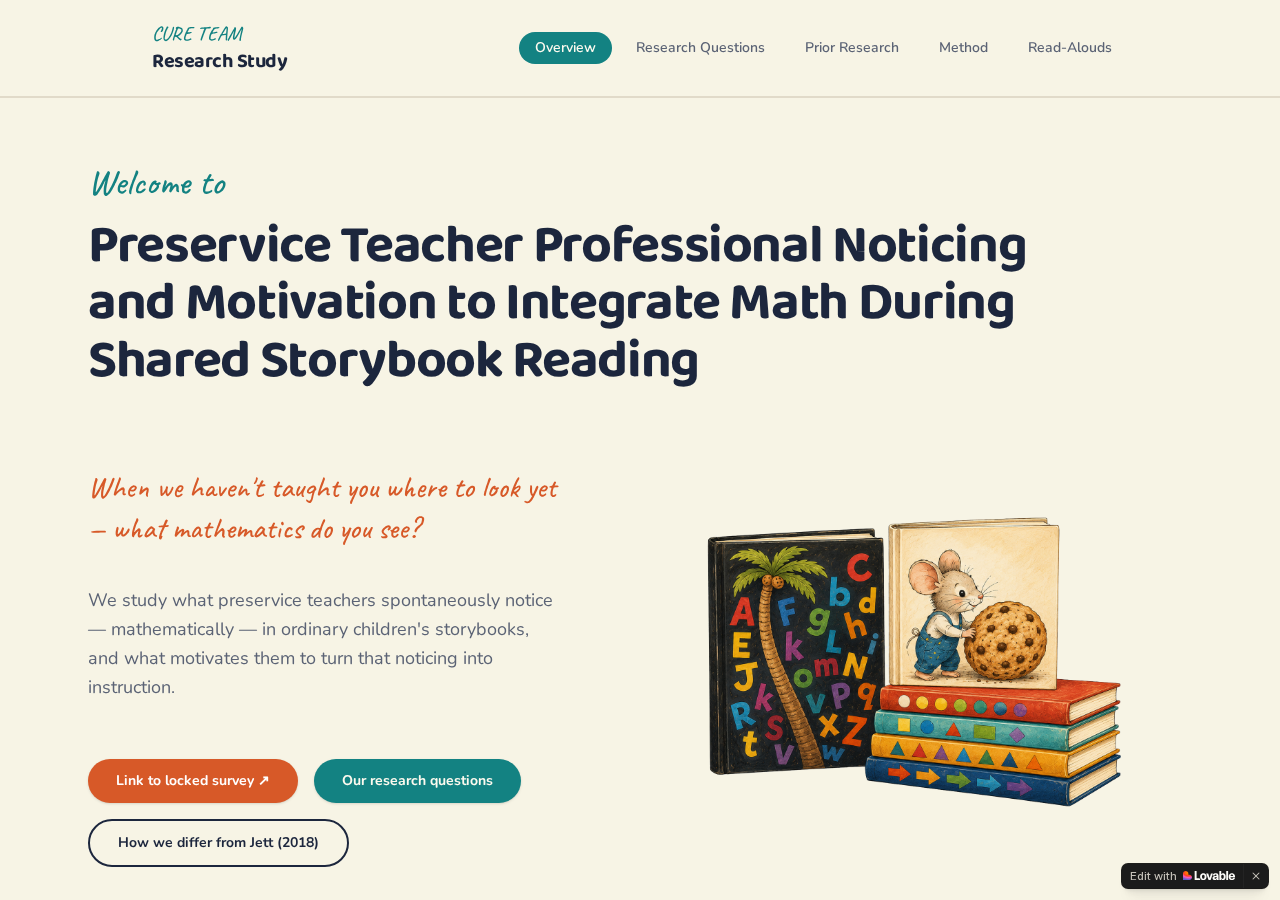
Math Spark — CURE Research Team
A course-based undergraduate research experience studying preservice teacher professional noticing and motivation to integrate math during shared storybook reading.
Selected Publications
Peer-reviewed, and still cited.
- 01
Strategies for fostering inclusivity, respect, and social-emotional learning in P-12 classrooms
Ristow, A. M., & Kammer, N.
Strategies for Addressing Social-Emotional Needs of Learners (IGI Global) · 2026
A practical framework for integrating social-emotional learning, inclusivity, and respect into P–12 classrooms — including how artificial intelligence can support that work responsibly.
- 02
How school leaders can support teachers with program implementation
Boyle, C., Wills, M., Jackson, L. E., & Kammer, N.
Inclusive Education in the 21st Century (IGI Global) · 2021
Positions continuous reflective practice as the driver of durable change, and shows how leaders sustain implementation rather than launch and walk away.
Earlier reading comprehension work was published under my maiden name, N. T. Scafiddi, with the Concept-Oriented Reading Instruction team at the University of Maryland. See the full publication record →
Research Highlights
Four themes that run through the SEL and inclusivity work.
Drawn from the IGI Global chapters above — translated out of academic language and into what they actually ask a school to do.
Belonging is a precondition for learning
Inclusivity and respect aren't a separate curriculum bolted onto the school day. They're the conditions comprehension and engagement work depends on — a student who doesn't feel safe in the room isn't available for the strategy instruction.
Where this shows up — Shapes the opening frame of every faculty institute — and the family-facing tools in Survival Mode.
SEL that survives the school year
Most SEL initiatives don't fail at launch — they fail in February. Continuous reflective practice, and leaders who stay present after the kickoff, are what carry a program from adoption to actual practice.
Where this shows up — The backbone of leadership retreats and implementation sessions.
AI in service of relationship
Artificial intelligence can carry the load that pulls teachers away from students — planning, differentiation, documentation. It should never carry the parts of SEL that require a human being who knows the child.
Where this shows up — The guardrail I teach in every AI build session.
Respect as a practice, not a poster
Inclusivity becomes real when it's observable: how turns are distributed, how disagreement is handled, whose work gets displayed. The chapter framework turns those values into routines a teacher can run on a Tuesday.
Where this shows up — Runs through the writing and curriculum studios.
In the workshops
Themes become sessions.
Faculty institutes open with belonging as the condition for learning. Curriculum studios turn respect into observable classroom routines. Leadership retreats focus on the February problem — the reflective structures that keep an SEL initiative alive long after the launch.
See the Workshops →In the writing
Themes become chapters.
The 2026 and 2021 chapters are where this framework was first argued in print, and they feed directly into the book-length work in progress — creative, inclusive practice written for the educators and leaders who have to make it hold up in a real building.
See the Books →Current Areas of Inquiry
Reading comprehension & engagement
How motivation support and strategy instruction work together to move comprehension — the through-line of my published research.
Informational text & benchmarks
What comprehension of information text actually looks like at each stage, and how to set instructional targets that hold up.
AI-assisted literacy tools
Translating comprehension research into working products — adaptive practice, guided questioning, and reading lenses families can use.
Teacher-built technology
What happens to instruction when educators can design and ship their own tools instead of waiting on vendors.
From Study to Software
“The comprehension research is clear. The gap has always been delivery — so I build the delivery.”
Word Adventures USA and The Storybook Coach are direct descendants of this work: motivation support, purposeful questioning, and strategy instruction, packaged so a teacher or parent can use them tonight.